

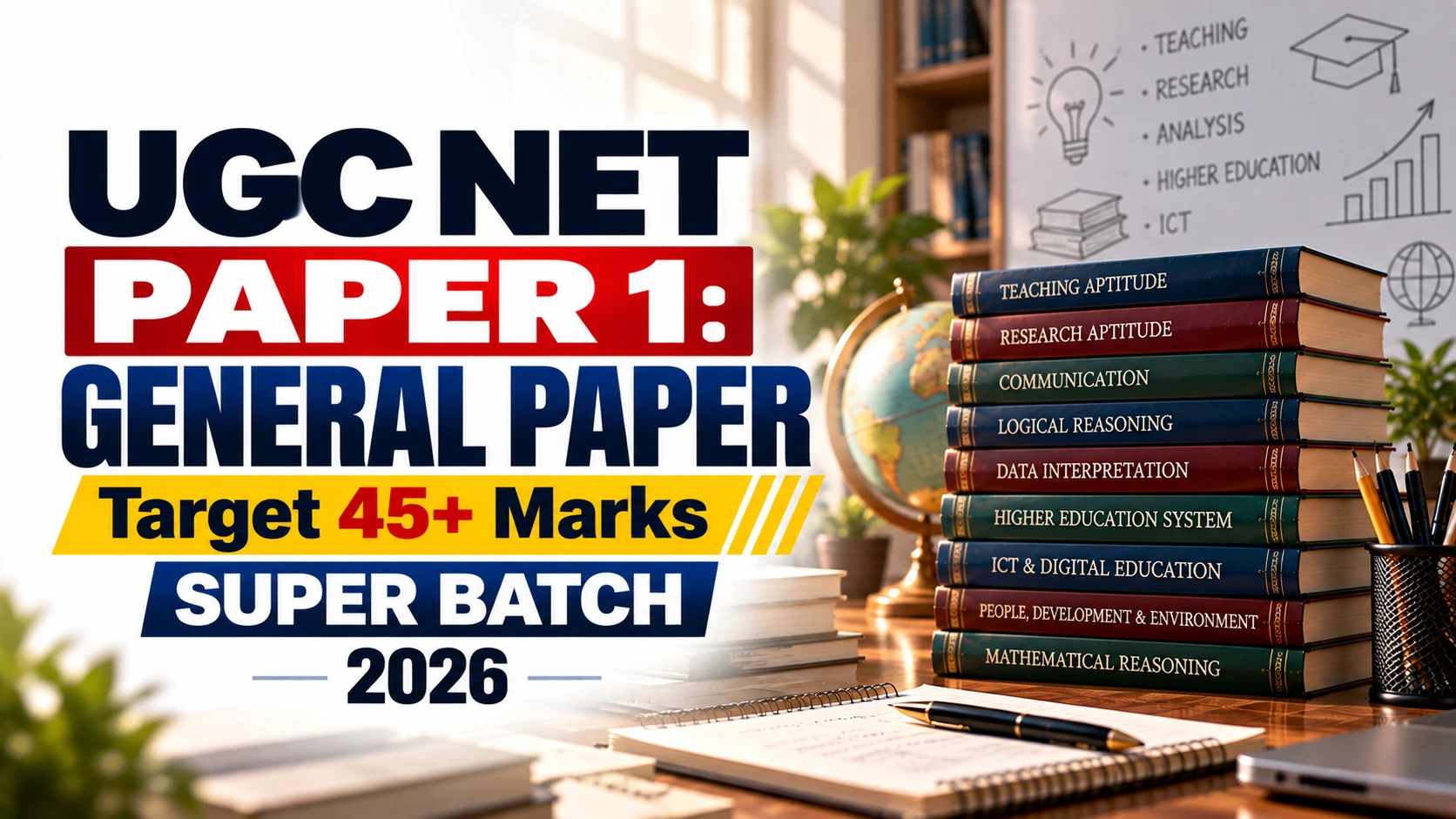
UGC NET Paper 1: General Paper (Target 45+ Marks Super Batch)
Master all 10 units of Paper 1: Teaching & Research Aptitude, Mathematical Reasoning, Indian Logic, ICT, and Higher Education with Vedic math shortcuts and 2,000+ solved MCQs.
Created by Boostabrain Senior Academic Faculty & JRF Panel
What You Will Get In This Batch
Live & Recorded Classes
Interactive lectures with full HD recordings & multi-speed control
Daily Practice Problems (DPPs)
Unit-wise question sets with step-by-step solutions
Handwritten Notes & Mind Maps
Crisp chapter summaries for rapid last-minute revision
All India CBT Mock Tests
Real NTA test interface with percentile & ranking analysis
Direct Faculty Doubt Clearance
Daily live doubt sessions directly with subject mentors
Full Course Validity
Unrestricted video access and PDF downloads for the batch validity period
Course Description & Overview
Crack UGC NET Paper 1 with 45+ Marks Guaranteed Strategy
Paper 1 is the decisive rank booster for securing a Junior Research Fellowship (JRF). Our Target 45+ Marks Super Batch breaks down complex Indian Logic, Mathematical calculations, and Environmental conventions into easy-to-remember memory frameworks.
Course Features:
- All 10 Paper 1 Units in High Definition: Concept theory + live MCQ practice.
- Vedic Math & DI Shortcuts: Solve Data Interpretation and Math questions in under 45 seconds.
- Indian Logic Mastery: Simplified Hetvabhasa, Pramanas, and Square of Opposition.
- NEP 2020 & Higher Education Updates: Latest government schemes, digital portals, and current affairs.
- 30 Full CBT Mock Tests: Timer-based real exam simulation with in-depth solutions.
Eligibility Criteria
All aspirants appearing for UGC NET / JRF across all 83 subjects.
Key Learning Outcomes
Complete Paper 1 in 50 minutes during exam, attain 45+ out of 50 correct questions, master Indian Logic.
Syllabus & Unit-Wise Structure
100% NTA Exam pattern aligned syllabus
- Teaching – concept, objectives, levels (memory, understanding, reflective), characteristics and basic requirements
- Learner characteristics – academic, social, emotional, cognitive; individual differences
- Factors affecting teaching – teacher, learner, support material, facilities, environment, institution
- Methods of teaching in higher education – teacher-centred vs learner-centred; offline vs online (SWAYAM, SWAYAM Prabha, MOOCs)
- Teaching support systems – traditional, modern, ICT-based
- Evaluation systems – elements, types; evaluation in CBCS; computer-based testing; innovations
- Research – meaning, types, characteristics; positivism and post-positivism
- Methods – experimental, descriptive, historical, qualitative, quantitative
- Steps of research
- Thesis and article writing – format and referencing styles
- Application of ICT in research
- Research ethics
- A passage of text followed by questions based on it
- Communication – meaning, types, characteristics
- Effective communication – verbal and non-verbal, inter-cultural, group, classroom
- Barriers to effective communication
- Mass media and society
- Types of reasoning
- Number series, letter series, codes and relationships
- Mathematical aptitude – fraction, time and distance, ratio, proportion, percentage, profit and loss, interest and discounting, averages
- Structure of arguments – argument forms, categorical propositions, mood and figure, formal and informal fallacies, uses of language, connotation and denotation, square of opposition
- Deductive and inductive reasoning
- Analogies
- Venn diagrams
- Indian logic – pramanas: pratyaksha, anumana, upamana, shabda, arthapatti, anupalabdhi
- Structure and kinds of anumana; vyapti; hetvabhasas
- Sources, acquisition and classification of data
- Quantitative and qualitative data
- Graphical representation – bar chart, histogram, pie chart, table, line chart; mapping of data
- Data interpretation
- Data and governance
- ICT – general abbreviations and terminology
- Internet, intranet, email, audio and video conferencing
- Digital initiatives in higher education
- ICT and governance
- Development and environment – MDGs and SDGs
- Human–environment interaction; anthropogenic impacts
- Environmental issues – air, water, soil, noise pollution; waste; climate change
- Impact of pollutants on human health
- Natural and energy resources – solar, wind, hydro, geothermal, biomass, nuclear, forests
- Natural hazards and disasters – mitigation
- Environment Protection Act 1986; NAPCC; Montreal, Rio, CBD, Kyoto, Paris; International Solar Alliance
- Institutions of higher learning in ancient India
- Evolution of higher learning and research after independence
- Oriental, conventional and non-conventional learning programmes
- Professional, technical and skill-based education
- Value education and environmental education
- Policies, governance and administration
Frequently Asked Questions
Yes! Every single live lecture is recorded in full 1080p HD and uploaded to your student portal within 2 hours. You can re-watch with unlimited playback speed options (1x, 1.25x, 1.5x, 2x) on both mobile and laptop with no expiry during your validity.
You receive high-yield unit-wise PDF notes, handwritten mind maps, solved 10-year PYQ booklets, and formula sheets which can be viewed or downloaded directly for offline revision.
Our CBT (Computer-Based Test) platform replicates the exact NTA exam interface, countdown timer, question palette, and negative marking rules, accompanied by detailed question-level analytics and All-India Rank (AIR).
You get direct access to our live interactive doubt sessions, dedicated WhatsApp/Telegram mentor groups, and 1-on-1 scheduled doubt-clearing sessions with 3x UGC-NET qualified educators.
Yes, we support easy monthly installments and zero-cost EMI on major credit/debit cards and UPI apps. Speak with our academic counselor for custom fee plans.
Limited Time Admission Price • Valid Till Batch Starts
This course batch includes:
Need Guidance from a Mentor?
Call Helpline: +9170990 05541