
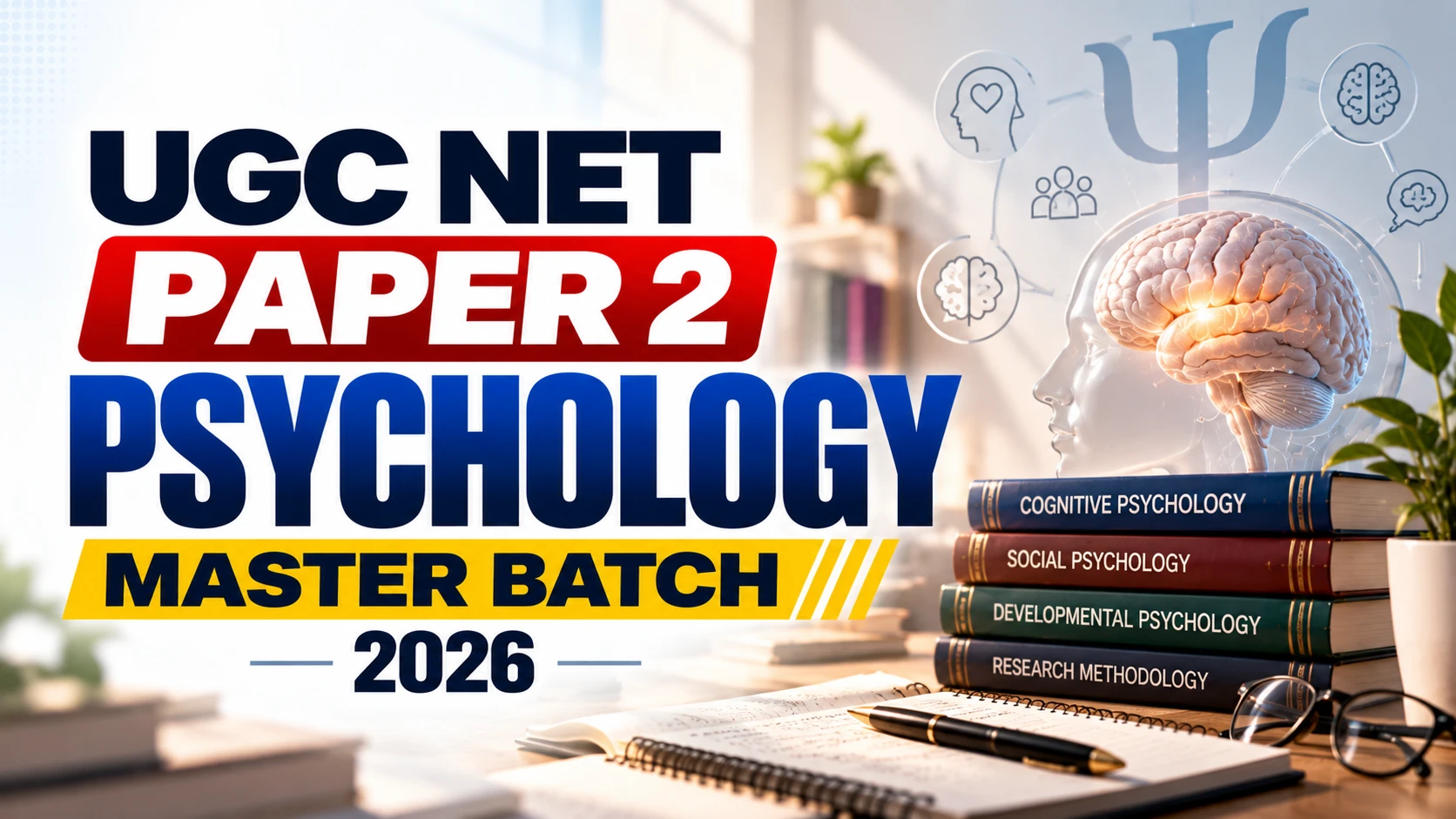
UGC NET Paper 2 Psychology (Master Batch 2026)
Comprehensive NTA UGC NET Master Batch for Psychology covering full updated 2026 syllabus with unit-wise mock test series and mentorship.
Created by Boostabrain Senior Academic Faculty & JRF Panel
What You Will Get In This Batch
Live & Recorded Classes
Interactive lectures with full HD recordings & multi-speed control
Daily Practice Problems (DPPs)
Unit-wise question sets with step-by-step solutions
Handwritten Notes & Mind Maps
Crisp chapter summaries for rapid last-minute revision
All India CBT Mock Tests
Real NTA test interface with percentile & ranking analysis
Direct Faculty Doubt Clearance
Daily live doubt sessions directly with subject mentors
Full Course Validity
Unrestricted video access and PDF downloads for the batch validity period
Course Description & Overview
Boostabrain Academy's flagship UGC NET Psychology Master Program provides complete conceptual clarity, unit-wise structured modules, live doubt resolution, and high-yield previous year question solvers.
Syllabus & Unit-Wise Structure
100% NTA Exam pattern aligned syllabus
- Psychological thought in Indian traditions – Yoga, Buddhism, Bhagavad Gita, Sufism
- Western schools – structuralism, functionalism, behaviourism, psychoanalysis, Gestalt, humanistic, cognitive
- Psychology as a science; paradigm shifts
- Indigenous and Indian psychology
- Research – meaning, purpose; variables and hypotheses
- Designs – experimental, quasi-experimental, correlational, ex post facto
- Sampling; methods – observation, interview, survey, case study
- Qualitative approaches – grounded theory, phenomenology, ethnography, discourse analysis
- Parametric statistics – t, ANOVA, ANCOVA, correlation, regression, factor analysis
- Non-parametric tests – chi-square, Mann-Whitney, Kruskal-Wallis
- Types of tests
- Test construction – item writing, item analysis
- Reliability, validity, norms and standardisation
- Tests of intelligence, aptitude and personality (self-report and projective)
- Neuropsychological assessment
- Applications in education, clinical, counselling and industrial settings; ethical issues
- Neurons, synaptic transmission, neurotransmitters
- Structure and functions of the brain
- Endocrine system and behaviour
- Genetics and behaviour
- Methods – EEG, fMRI, PET, lesion studies
- Sleep and states of consciousness
- Attention – forms and models (Broadbent, Treisman, Deutsch)
- Perception – Gestalt principles, depth, constancy, illusions, signal detection
- Learning – classical and operant conditioning, observational and cognitive learning
- Memory – Atkinson-Shiffrin, working memory, levels of processing; types of long-term memory
- Forgetting – decay, interference, retrieval failure; reconstructive memory
- Theories of thinking – Piaget, Vygotsky, Bruner
- Concept formation; deductive and inductive reasoning
- Problem solving and decision making; heuristics
- Language and thought
- Intelligence – Spearman, Thurstone, Cattell, Guilford, Gardner, Sternberg, PASS; emotional intelligence
- Creativity – theories, measurement and fostering
- Personality – psychodynamic (Freud, Jung, Adler, Horney, Erikson), trait (Allport, Cattell, Eysenck, Big Five), humanistic (Rogers, Maslow), social-cognitive (Bandura)
- Indian approaches to personality
- Motivation – drive, arousal, need theories; intrinsic and extrinsic
- Emotion – James-Lange, Cannon-Bard, Schachter-Singer, Lazarus
- Stress – sources and models; coping strategies
- Social cognition and attribution
- Attitudes and persuasion
- Prejudice and discrimination
- Social influence – conformity, compliance, obedience
- Group processes; prosocial behaviour; aggression
- Interpersonal attraction; intergroup relations
- Social psychology in the Indian context
- Life-span development – prenatal to old age
- Theories – Piaget, Erikson, Kohlberg, Bronfenbrenner; attachment
- Psychopathology – DSM and ICD classification; major disorders
- Psychotherapies – psychodynamic, behavioural, CBT, REBT, humanistic
- Counselling and community interventions
- Positive psychology
- Health psychology
- Environmental psychology
- Cross-cultural psychology
- Organisational psychology
- Sports psychology
- Cyber psychology; gender and psychology
- Peace and conflict studies
Frequently Asked Questions
All live classes are streamed directly inside the Boostabrain App and Web Portal. If you miss a live session, high-quality recorded backup videos with multi-speed controls will be made available within 2 hours.
Yes! You will receive downloadable unit-wise PDF study notes, handwritten mind maps, and Daily Practice Problems (DPPs) after every class.
This course comes with 6 Months full access validity from the date of enrollment.
You can ask live text/audio doubts during classes. Additionally, our faculty mentors provide daily direct doubt resolution sessions.
Yes, you can watch classes on Android mobile app, iOS app, tablets, laptops, and desktop computers.
Limited Time Admission Price • Valid Till Batch Starts
This course batch includes:
Need Guidance from a Mentor?
Call Helpline: +9170990 05541