
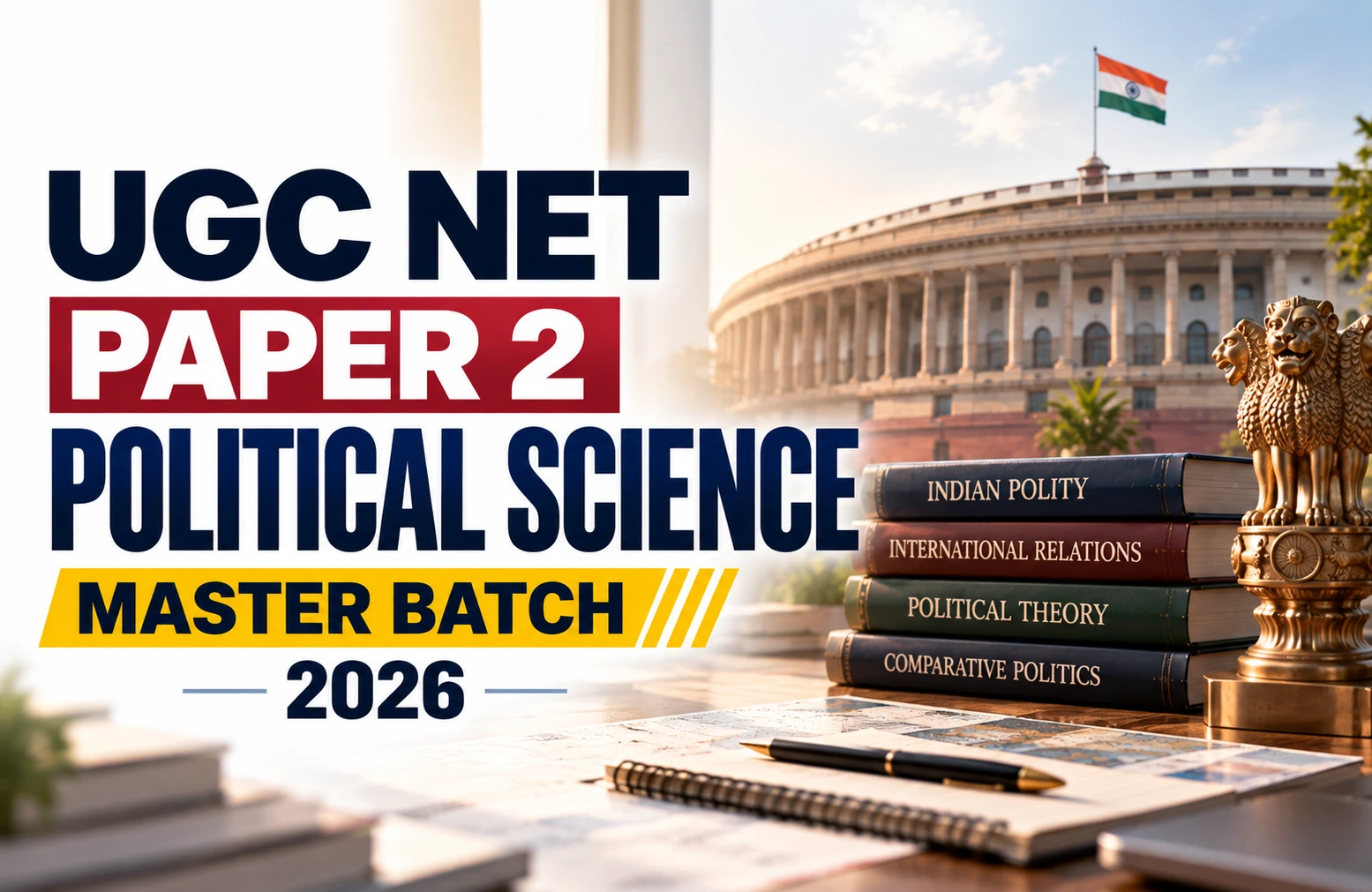
UGC NET Paper 2 Political Science (Master Batch 2026)
Comprehensive NTA UGC NET Master Batch for Political Science covering full updated 2026 syllabus with unit-wise mock test series and mentorship.
Created by Boostabrain Senior Academic Faculty & JRF Panel
What You Will Get In This Batch
Live & Recorded Classes
Interactive lectures with full HD recordings & multi-speed control
Daily Practice Problems (DPPs)
Unit-wise question sets with step-by-step solutions
Handwritten Notes & Mind Maps
Crisp chapter summaries for rapid last-minute revision
All India CBT Mock Tests
Real NTA test interface with percentile & ranking analysis
Direct Faculty Doubt Clearance
Daily live doubt sessions directly with subject mentors
Full Course Validity
Unrestricted video access and PDF downloads for the batch validity period
Course Description & Overview
Boostabrain Academy's flagship UGC NET Political Science Master Program provides complete conceptual clarity, unit-wise structured modules, live doubt resolution, and high-yield previous year question solvers.
Syllabus & Unit-Wise Structure
100% NTA Exam pattern aligned syllabus
- Concepts – liberty, equality, justice, rights, democracy, power, citizenship
- Traditions – liberalism, conservatism, socialism, Marxism, feminism, ecologism, multiculturalism, postmodernism
- Confucius, Plato, Aristotle
- Machiavelli, Hobbes, Locke, Rousseau
- Hegel, Mary Wollstonecraft, J.S. Mill, Marx
- Gramsci, Hannah Arendt, Frantz Fanon, Mao Zedong, John Rawls
- Dharmashastra, Kautilya, Aggañña Sutta
- Barani, Kabir
- Pandita Ramabai, Tilak, Vivekananda, Tagore
- Gandhi, Aurobindo, Periyar, Iqbal
- M.N. Roy, Savarkar, Ambedkar, Nehru
- Lohia, Jayaprakash Narayan, Deendayal Upadhyaya
- Approaches – institutional, political culture, political economy, new institutionalism; comparative method
- Colonialism and decolonisation; nationalism
- State theory; democratic and non-democratic regimes
- Constitutions and constitutionalism; democratisation
- Electoral systems, political parties, pressure groups, social movements, civil society
- Approaches – realism, neo-realism, liberalism, neo-liberalism, Marxism, feminism, constructivism, non-Western perspectives
- Concepts – state, sovereignty, national interest, power, balance of power, security, deterrence
- Conflict and peace; United Nations
- Political economy – globalisation, global governance, Bretton Woods, WTO, North-South
- Regional organisations – EU, AU, ASEAN, SCO
- Contemporary challenges – terrorism, climate change, human rights, migration
- Perspectives, continuity and change
- Relations with USA, Russia, China, EU
- Neighbourhood policy; Act East
- Multilateral engagement – UN, G20, BRICS, IBSA, SCO, SAARC, BIMSTEC
- Nuclear policy
- Making of the Constitution; Constituent Assembly
- Preamble, Fundamental Rights, Directive Principles
- Union executive, Parliament and judiciary
- Federalism and Centre-State relations
- Constitutional and statutory bodies – ECI, CAG, Finance Commission, UPSC, NHRC, NCW, NCSC, NCST
- Amendment and basic structure
- State, economy and development
- Identity politics – caste, religion, language, region
- Social movements and civil liberties
- Electoral process, party system, coalition politics
- Regionalism; voting behaviour
- Theories – classical, scientific management, human relations, Weber’s bureaucracy, rational choice
- New Public Administration, New Public Management, New Public Service
- Development and comparative administration
- Public policy; good governance; accountability; e-governance
- Governance, good governance, democratic governance
- Accountability mechanisms – RTI, Lokpal, CVC, citizens’ charters
- Grassroots governance – Panchayati Raj and urban local bodies
- Planning and development – NITI Aayog
- Public policy process; monitoring and evaluation
- Welfare schemes; e-governance and Digital India
Frequently Asked Questions
All live classes are streamed directly inside the Boostabrain App and Web Portal. If you miss a live session, high-quality recorded backup videos with multi-speed controls will be made available within 2 hours.
Yes! You will receive downloadable unit-wise PDF study notes, handwritten mind maps, and Daily Practice Problems (DPPs) after every class.
This course comes with 6 Months full access validity from the date of enrollment.
You can ask live text/audio doubts during classes. Additionally, our faculty mentors provide daily direct doubt resolution sessions.
Yes, you can watch classes on Android mobile app, iOS app, tablets, laptops, and desktop computers.
Limited Time Admission Price • Valid Till Batch Starts
This course batch includes:
Need Guidance from a Mentor?
Call Helpline: +9170990 05541