

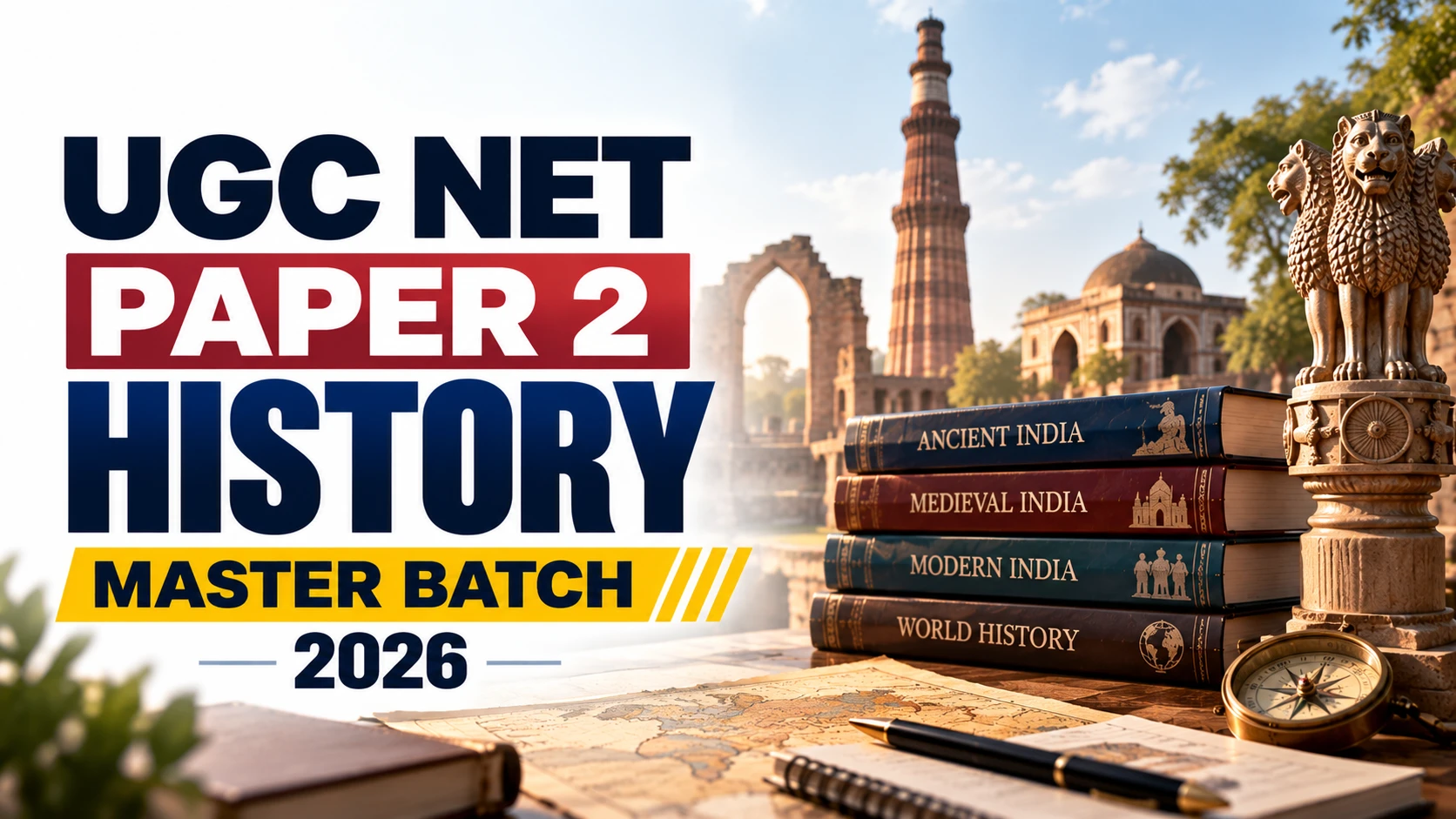
UGC NET Paper 2 History (Master Batch 2026)
Comprehensive NTA UGC NET Master Batch for History covering full updated 2026 syllabus with unit-wise mock test series and mentorship.
Created by Boostabrain Senior Academic Faculty & JRF Panel
What You Will Get In This Batch
Live & Recorded Classes
Interactive lectures with full HD recordings & multi-speed control
Daily Practice Problems (DPPs)
Unit-wise question sets with step-by-step solutions
Handwritten Notes & Mind Maps
Crisp chapter summaries for rapid last-minute revision
All India CBT Mock Tests
Real NTA test interface with percentile & ranking analysis
Direct Faculty Doubt Clearance
Daily live doubt sessions directly with subject mentors
Full Course Validity
Unrestricted video access and PDF downloads for the batch validity period
Course Description & Overview
Boostabrain Academy's flagship UGC NET History Master Program provides complete conceptual clarity, unit-wise structured modules, live doubt resolution, and high-yield previous year question solvers.
Syllabus & Unit-Wise Structure
100% NTA Exam pattern aligned syllabus
- Archaeological and literary sources; foreign accounts
- Palaeolithic, Mesolithic, Neolithic and Chalcolithic cultures
- Harappan civilisation – origin, extent, features, decline, continuity
- Vedic and later Vedic polity, society, economy, religion
- Iron Age; Mahajanapadas; rise of Magadha
- Jainism, Buddhism and other heterodox sects
- Persian and Macedonian invasions
- Mauryan empire – administration, economy, Ashoka’s Dhamma, art, decline
- Post-Mauryan – Sungas, Indo-Greeks, Sakas, Kushanas
- Satavahanas
- Sangam age – literature, polity, society
- Guptas and Vakatakas – administration, economy, literature, science, art
- Harshavardhana
- Trade with Rome and Southeast Asia
- Chalukyas, Rashtrakutas, Pallavas, Cholas, Pandyas
- Palas, Pratiharas, Senas; Rajputs; Kamarupa
- Arab conquest of Sind; Ghaznavid and Ghurid invasions
- Early medieval debates – feudalism, agrarian expansion, urban decline
- Temple economy; Alvars and Nayanars
- Art and architecture – Nagara, Dravida, Vesara
- Persian chronicles and travellers’ accounts
- Delhi Sultanate – Mamluks, Khaljis, Tughlaqs, Sayyids, Lodis
- Vijayanagara and Bahmani kingdoms; provincial kingdoms
- Mughal empire – Babur to Aurangzeb; Sher Shah
- Rajput and Deccan policies
- Marathas – Shivaji; the Ahoms
- Decline of the Mughal empire
- Sultanate administration – iqta system; Alauddin’s market reforms
- Mughal administration – mansabdari and jagirdari
- Land revenue – zabt, dahsala; zamindars and agrarian relations
- Trade, commerce, urbanisation; monetisation and banking
- Technology and crafts
- European trading companies
- Bhakti movement – Kabir, Nanak, Chaitanya, Mirabai, Sankardeva
- Sufi silsilas
- Sikhism; Akbar’s religious policy
- Persian and regional literature
- Indo-Islamic and Mughal architecture; Mughal and Rajput painting; music
- Women and society
- Sources of modern Indian history
- Rise of British power – Plassey, Buxar; Anglo-Mysore, Anglo-Maratha, Anglo-Sikh wars
- Subsidiary Alliance; Doctrine of Lapse
- Land revenue settlements – Permanent, Ryotwari, Mahalwari
- Colonial economy – deindustrialisation, drain of wealth, commercialisation of agriculture, famines, railways
- Revolt of 1857
- Socio-religious reform – Brahmo Samaj, Arya Samaj, Prarthana Samaj, Ramakrishna Mission, Aligarh movement, Satyashodhak Samaj
- Caste and women’s questions
- Press and education
- Peasant and tribal movements
- Early nationalism and the Indian National Congress
- Moderates and extremists; Swadeshi movement; revolutionary movements
- Home Rule; Gandhian movements – Non-Cooperation, Civil Disobedience, Quit India
- Left movements; communalism; Muslim League; Partition
- INA; transfer of power
- Constitution making; integration of princely states; linguistic reorganisation
- Nehruvian era – planning and foreign policy
- History – concept, scope; relation with other disciplines
- Sources, evidence, objectivity, causation
- Approaches – imperialist, nationalist, Marxist, subaltern, Cambridge school, post-modern
- Annales school
- Research methodology in history
- Major historians – Ranke, Carr, Kosambi, R.S. Sharma, Romila Thapar, Irfan Habib, Bipan Chandra, Ranajit Guha
Frequently Asked Questions
All live classes are streamed directly inside the Boostabrain App and Web Portal. If you miss a live session, high-quality recorded backup videos with multi-speed controls will be made available within 2 hours.
Yes! You will receive downloadable unit-wise PDF study notes, handwritten mind maps, and Daily Practice Problems (DPPs) after every class.
This course comes with 6 Months full access validity from the date of enrollment.
You can ask live text/audio doubts during classes. Additionally, our faculty mentors provide daily direct doubt resolution sessions.
Yes, you can watch classes on Android mobile app, iOS app, tablets, laptops, and desktop computers.
Limited Time Admission Price • Valid Till Batch Starts
This course batch includes:
Need Guidance from a Mentor?
Call Helpline: +9170990 05541