
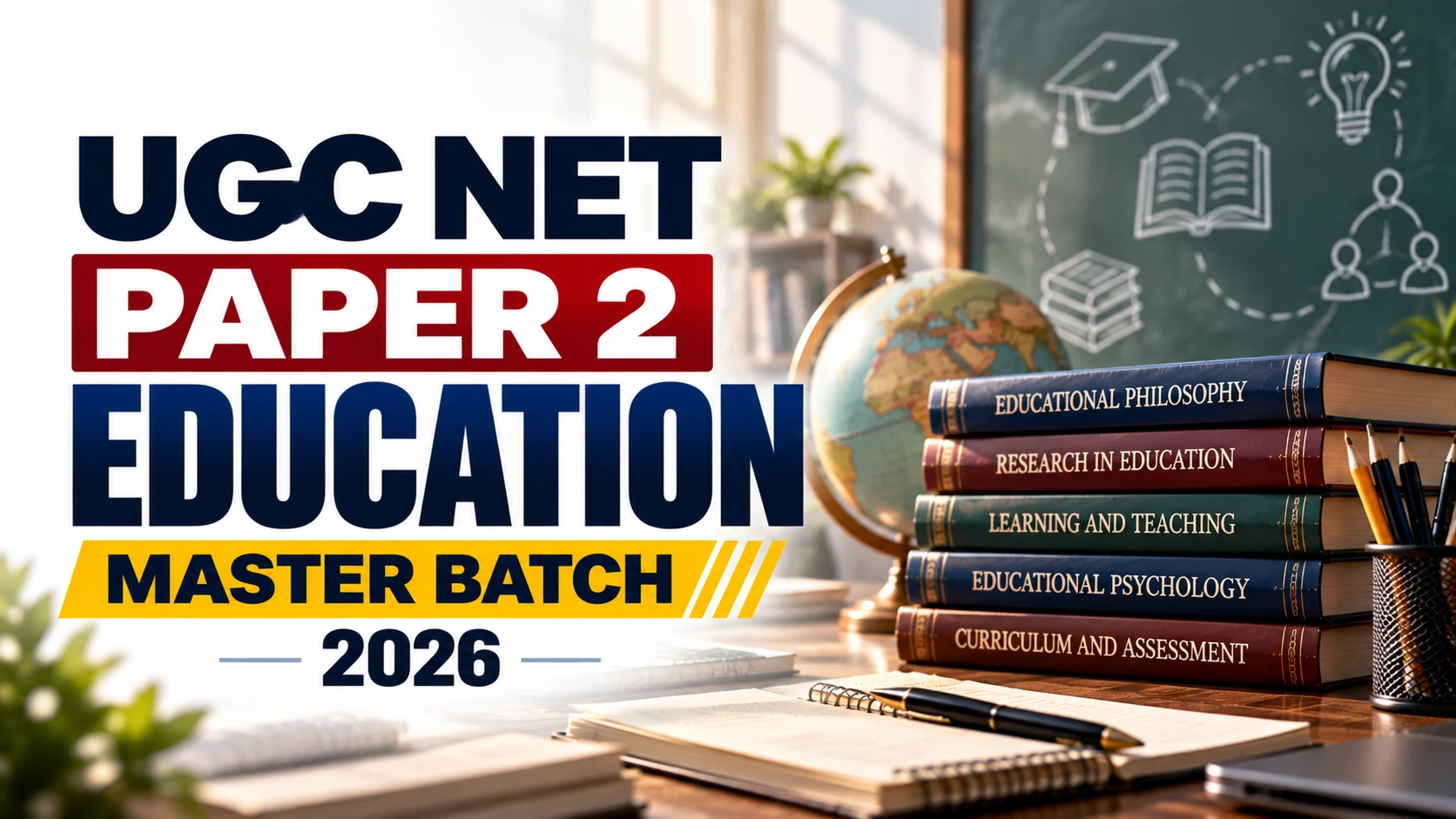
UGC NET Paper 2 Education (Master Batch 2026)
Comprehensive NTA UGC NET Master Batch for Education covering full updated 2026 syllabus with unit-wise mock test series and mentorship.
Created by Boostabrain Senior Academic Faculty & JRF Panel
What You Will Get In This Batch
Live & Recorded Classes
Interactive lectures with full HD recordings & multi-speed control
Daily Practice Problems (DPPs)
Unit-wise question sets with step-by-step solutions
Handwritten Notes & Mind Maps
Crisp chapter summaries for rapid last-minute revision
All India CBT Mock Tests
Real NTA test interface with percentile & ranking analysis
Direct Faculty Doubt Clearance
Daily live doubt sessions directly with subject mentors
Full Course Validity
Unrestricted video access and PDF downloads for the batch validity period
Course Description & Overview
Boostabrain Academy's flagship UGC NET Education Master Program provides complete conceptual clarity, unit-wise structured modules, live doubt resolution, and high-yield previous year question solvers.
Syllabus & Unit-Wise Structure
100% NTA Exam pattern aligned syllabus
- Indian schools of philosophy – Sankhya-Yoga, Vedanta, Buddhism, Jainism, Islamic traditions – on knowledge, reality and values
- Western schools – idealism, realism, naturalism, pragmatism, existentialism, Marxism
- Thinkers – Gandhi, Tagore, Vivekananda, Aurobindo, J. Krishnamurti, Plato, Rousseau, Dewey, Freire, Illich
- Epistemology, metaphysics and axiology in education
- Sociology of education – socialisation, culture, social change
- Education, democracy and constitutional values
- Education in ancient, medieval and colonial India
- Macaulay’s Minute, Wood’s Despatch, Hunter Commission, Sadler Commission, Wardha scheme
- Post-independence commissions – Radhakrishnan, Mudaliar, Kothari; NPE 1986/1992; NEP 2020
- Constitutional provisions; RTE Act, 2009
- Politics of education
- Economics of education – human capital, cost-benefit analysis, financing
- Growth and development – physical, cognitive, social, emotional, moral
- Piaget, Vygotsky, Bruner, Erikson, Kohlberg
- Learning theories – behaviourist, cognitive, constructivist, social learning, Gestalt
- Intelligence – Spearman, Thurstone, Guilford, Gardner, Sternberg; emotional intelligence
- Creativity; motivation; personality
- Individual differences; mental health and adjustment
- Concept, aims and scope
- Historical development in India
- Pre-service and in-service teacher education
- Agencies – NCTE, NCERT, SCERT, DIETs, IASEs, CTEs
- Curriculum frameworks for teacher education
- Teaching skills, micro-teaching, internship
- Professional development; research in teacher education
- Curriculum – concept, principles, determinants
- Types of curriculum; hidden curriculum
- Curriculum development models – Tyler, Taba, Wheeler
- National curriculum frameworks – NCF 2005, NCF-SE 2023
- Curriculum implementation and evaluation
- Curriculum change and reform
- Research – nature, types, paradigms (quantitative, qualitative, mixed)
- Research problem, hypotheses, review of literature
- Sampling; tools – validity and reliability
- Methods – descriptive, experimental, historical, ethnography, case study, action research
- Descriptive and inferential statistics – t, ANOVA, chi-square, correlation, regression
- Qualitative data analysis
- Research proposal and report writing
- Pedagogy – concept and approaches
- Models of teaching – concept attainment, advance organiser, inquiry training
- Andragogy – Knowles’ principles of adult learning
- Assessment – formative, summative, continuous and comprehensive
- Norm- and criterion-referenced testing; achievement and diagnostic tests
- Grading, credit systems; ICT in assessment
- Educational technology – concept, hardware and software approaches
- Systems approach to education
- Instructional design – ADDIE, Gagné’s events of instruction
- Communication models in the classroom
- E-learning, blended learning, MOOCs, SWAYAM, OER
- Programmed instruction; ICT policy in education
- Management – concept, principles, functions
- Theories – scientific management, administrative, bureaucratic, human relations
- Leadership – theories and styles
- Educational planning; institutional planning; supervision
- Quality assurance – TQM, NAAC, NBA, NIRF
- Financing and budgeting; regulatory bodies – UGC, AICTE, NCTE
- Inclusive education – concept, history, principles
- Types of disabilities and learning difficulties
- Legal and policy frameworks – RPwD Act 2016, RCI Act, UNCRPD, Salamanca Statement, NEP 2020
- Barriers to inclusion
- Curriculum adaptation; Universal Design for Learning; assistive technology
- Preparing teachers for inclusive classrooms
Frequently Asked Questions
All live classes are streamed directly inside the Boostabrain App and Web Portal. If you miss a live session, high-quality recorded backup videos with multi-speed controls will be made available within 2 hours.
Yes! You will receive downloadable unit-wise PDF study notes, handwritten mind maps, and Daily Practice Problems (DPPs) after every class.
This course comes with 6 Months full access validity from the date of enrollment.
You can ask live text/audio doubts during classes. Additionally, our faculty mentors provide daily direct doubt resolution sessions.
Yes, you can watch classes on Android mobile app, iOS app, tablets, laptops, and desktop computers.
Limited Time Admission Price • Valid Till Batch Starts
This course batch includes:
Need Guidance from a Mentor?
Call Helpline: +9170990 05541