

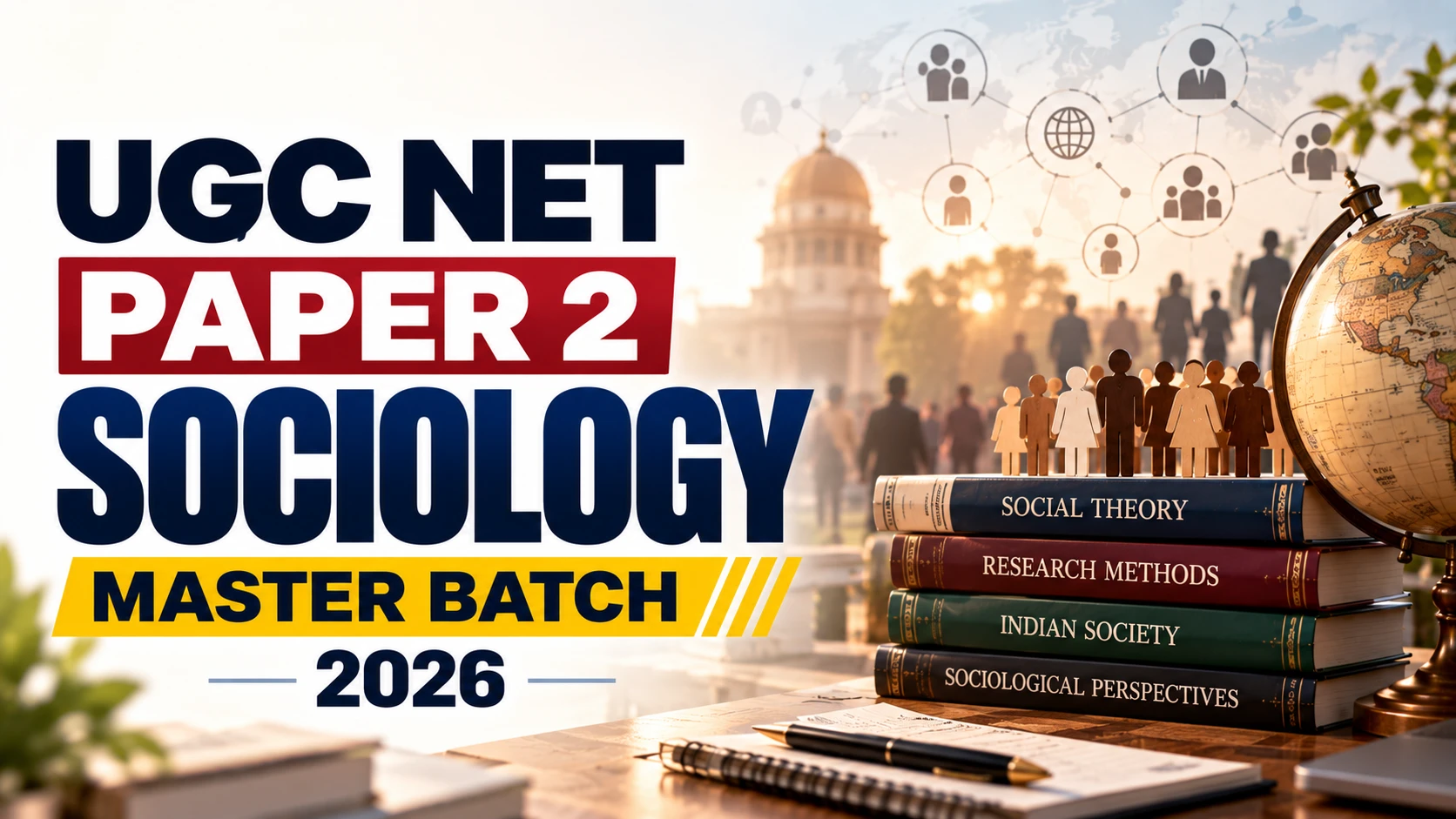
UGC NET Paper 2 Sociology (Master Batch 2026)
Comprehensive NTA UGC NET Master Batch for Sociology covering full updated 2026 syllabus with unit-wise mock test series and mentorship.
Created by Boostabrain Senior Academic Faculty & JRF Panel
What You Will Get In This Batch
Live & Recorded Classes
Interactive lectures with full HD recordings & multi-speed control
Daily Practice Problems (DPPs)
Unit-wise question sets with step-by-step solutions
Handwritten Notes & Mind Maps
Crisp chapter summaries for rapid last-minute revision
All India CBT Mock Tests
Real NTA test interface with percentile & ranking analysis
Direct Faculty Doubt Clearance
Daily live doubt sessions directly with subject mentors
Full Course Validity
Unrestricted video access and PDF downloads for the batch validity period
Course Description & Overview
Boostabrain Academy's flagship UGC NET Sociology Master Program provides complete conceptual clarity, unit-wise structured modules, live doubt resolution, and high-yield previous year question solvers.
Syllabus & Unit-Wise Structure
100% NTA Exam pattern aligned syllabus
- Classical theorists – Comte, Spencer, Marx, Durkheim, Weber, Simmel, Pareto
- Structural-functionalism and structuralism – Malinowski, Radcliffe-Brown, Parsons, Merton, Lévi-Strauss
- Interpretative perspectives – Mead, Blumer, Schutz, Berger and Luckmann, Garfinkel, Goffman
- Conflict theory – Dahrendorf, Coser, Frankfurt school
- Post-modern and post-structural – Foucault, Derrida, Habermas, Giddens, Bourdieu
- Indian thinkers – Ghurye, D.P. Mukerji, A.R. Desai, M.N. Srinivas, S.C. Dube, Irawati Karve, Ambedkar, Dumont
- Philosophical foundations – positivism and interpretivism
- Research design
- Quantitative and qualitative methods
- Techniques – survey, interview, observation, case study, focus group
- Sampling
- Statistics – central tendency, dispersion, correlation, regression, hypothesis testing
- Reliability and validity
- Society, community, association, institution
- Social structure, status and role; groups
- Socialisation and culture
- Stratification – caste, class, gender, ethnicity; social mobility
- Social change
- Religion, education, polity and economy as institutions
- Rural sociology; peasant studies; agrarian relations
- Land reforms; Green Revolution; rural development programmes
- Urban sociology – Chicago school and other theories
- Urbanisation; slums; migration
- Urban planning; smart cities
- State – nature and theories; power, authority, legitimacy
- Democracy and citizenship
- Political parties, pressure groups, social movements, civil society
- Development theories – modernisation, dependency, world-systems, human development
- Globalisation; sustainable development
- Development-induced displacement
- Economic sociology
- Forms of economy – hunting-gathering, pastoral, agrarian, industrial, post-industrial
- Gift, exchange and market – Mauss, Polanyi
- Work, labour and occupation; informal sector
- Industrialisation and globalisation
- Consumption
- Environmental sociology – perspectives
- Resource conflicts – water, forest, land
- Environmental movements – Chipko, Narmada Bachao, Silent Valley
- Environment and development; climate change
- Risk society; disasters
- Approaches – descent and alliance theories
- Kinship terminology; kinship in North and South India
- Family – types and changes; household
- Marriage – forms and rules
- Gender and family; dowry, divorce, domestic violence
- Sociology of science – Merton, Kuhn
- Technology and social change
- ICT and the network society – Castells
- Digital divide and new media
- Biotechnology and society; ethical issues
- Culture – concept and theories; symbols and meaning
- Popular culture and media
- Religion – theories, secularisation, fundamentalism
- Language and society
- Identity, ethnicity and nationalism
- Globalisation of culture
Frequently Asked Questions
All live classes are streamed directly inside the Boostabrain App and Web Portal. If you miss a live session, high-quality recorded backup videos with multi-speed controls will be made available within 2 hours.
Yes! You will receive downloadable unit-wise PDF study notes, handwritten mind maps, and Daily Practice Problems (DPPs) after every class.
This course comes with 6 Months full access validity from the date of enrollment.
You can ask live text/audio doubts during classes. Additionally, our faculty mentors provide daily direct doubt resolution sessions.
Yes, you can watch classes on Android mobile app, iOS app, tablets, laptops, and desktop computers.
Limited Time Admission Price • Valid Till Batch Starts
This course batch includes:
Need Guidance from a Mentor?
Call Helpline: +9170990 05541